Choose Your Delivery Schedule
Review the available date and time, then click Update to apply your selection.
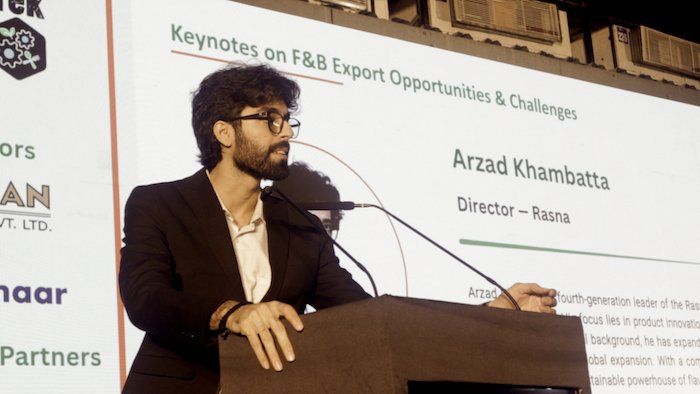
On a Saturday with incessant rain, waterlogging and flooding of all road and rail routes to Ahmedabad, the FoodTekPack Conference took place at the Indusfood exhibition in the twin city of Gandhinagar, amidst a still healthy turnout. Arzad Khambatta, the director of Rasna, gave a keynote talk in which he spoke about the opportunity that we have as an industry to increasingly process and deliver food and beverage products to the world rather than merely providing raw materials and ingredients. He also spoke of some of the challenges of exports when each SKU requires appropriate design and information compliant with the rules of each destination. “In case a consignment does not reach in time or is not accepted for any reason by a particular market, it cannot be repurposed since the packaging and labelling information have to be specific to each market,” he said.
In the Save Food and innovation session that followed, the opportunities to create value and protein production were discussed by Foram Badani, assistant director of the Indian Institute of Packaging, Ahmedabad, and by Milan Darji, team leader of Consumer Foods and Value and Nutrition at Buhler India. Darji spoke about technical innovations that can transform plant-based residues into a variety of valuable protein-rich products.
Badani spoke about the immense food loss in India right at the farm side and suggested remedies to reduce spoilage before it reaches markets and consumers. She suggested several appropriate passive and active technologies to bring farm produce to market and also extensively spoke about the importance of packaging for delivery to domestic and export consumers. Explaining the effects of heat and moisture on ripening and spoilage, she suggested that the use of active packaging using micro-perforated films and modified atmosphere packaging, known as MAP, can greatly mitigate food loss and enhance the intact and safe delivery of protein-rich foods over longer distances and time. Badani also spoke of the recent innovations in packaging security and connected packaging solutions.
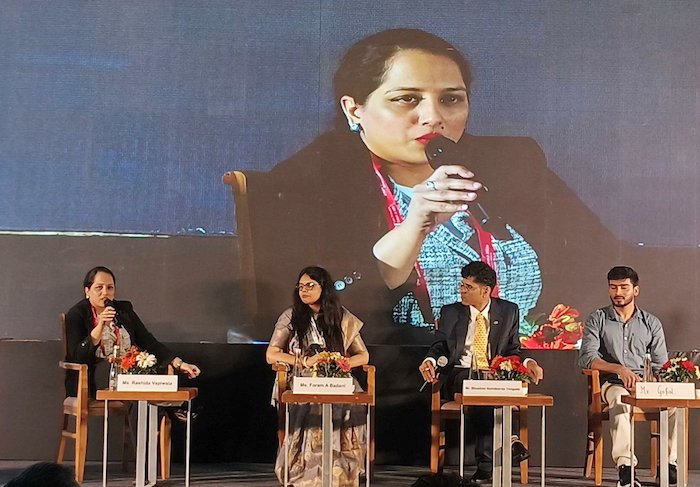
In the following session that discussed FSSAI regulations and compliance, Ms Badani provided an update of the latest rules while Dr Rashida Vapiwala presented her automated solution LabelBlind, that essentially keeps incorporating the latest FSSAI regulations and those of more than a dozen export markets for the purpose of generating compliance with their food import regulations and also the requisite labeling and packaging information. As demonstrated, this is a very thorough and scientific solution that automates the packaging and label process by firstly providing the information of what an export market requires and then producing the label that demonstrates compliance. This is a huge step forward in de-risking food exports. As Dr Vapivala says, “India’s food exports are at a defining moment. Global demand for food is growing, India is signing Free Trade Agreements, and the opportunity has never been greater. But are we ready to seize it?”
Speaking about her software solution, she says, “For years, regulatory compliance has been viewed as a cost or a barrier. It is time to change that mindset. Regulatory compliance, when digitized, creates a level playing field.
“It empowers businesses, whether a fast-growing startup or a large enterprise, to confidently navigate multiple country regulations, accelerate market entry, minimize compliance risks and compete globally with speed and precision. As India strengthens its position as a global food manufacturing and export hub, our competitiveness will depend on how intelligently we manage regulatory compliance across markets.
“The next decade belongs to companies that embed regulatory compliance into innovation, and Digitization is the way to do that. India is ready. Now it is time to scale with confidence, powered by technology and driven by regulatory compliance.”
Note: The FoodTekPack Conference in Gandhinagar was jointly organized by IppStar and the Trade Promotion Council of India with generous sponsorship support from Pelican Rotoflex and Echaar Equipments.
